Inside the demanding world of modern pro-level sliding, podium finishes is far more than purely a product of raw engine power or pilot courage. Conversely, it is now a intricate science that requires a scrupulous blend of picking a time-tested car, arming it with the highest-quality competition hardware, and, most essentially, understanding its dynamic performance on the course through advanced suspension tuning applications. This comprehensive handbook will serve as your blueprint from the initial concept of a drift build through to the last data-informed adjustments that elevate a strong machine into a consistent winner. We will examine in detail the art and science of car suspension tuning, demonstrating how a state-of-the-art suspension tuning tool like a dedicated telemetry system eliminates assumptions and offers exceptional clarity into your car's actual behavior.
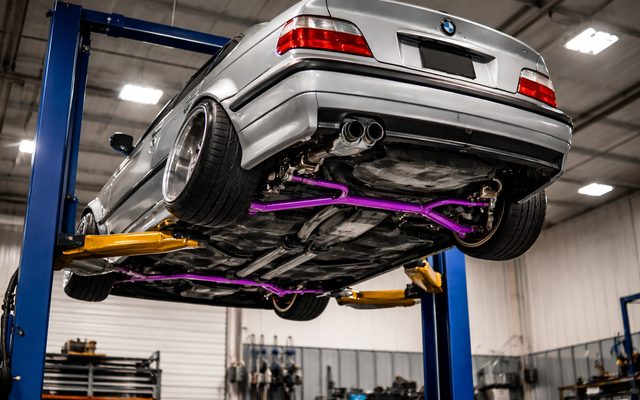
The bedrock of any exceptional drift machine is, indisputably, the chassis itself. A select group of cars have attained renowned reputation within the international oversteer community due to their natural handling characteristics, robust construction, and the immense ecosystem of aftermarket components available. Choosing the right platform is the initial and most crucial choice a builder will make. As an example, the BMW E36 is commonly accepted as one of the best overall drift platforms of the modern era. Its excellent evenly distributed mass, alongside a driven rear axle configuration and robust inline-six powerplants, creates a chassis that is both forgiving for beginners and incredibly effective in the hands of a pro pilot. The successor of this philosophy, the BMW E46 platform, improves on these attributes with a more developed structure, wider track for greater stability, and yet more steering angle straight from the manufacturer. A distinct dominant contender in the top-level circuit is the C6 generation Corvette.
This V8-powered track weapon brings a distinctive array of benefits to the sideways sport, including a lightweight aluminum chassis, a backwards-positioned transaxle that helps create an excellent front-to-rear mass ratio, and the colossal thrust of a big LS V8 motor. This fusion makes it an complete weapon on track, capable of starting and maintaining long angles with seemingly easy application of acceleration. For builders looking for outstanding performance per dollar, the Nissan 350Z excels as a top-tier choice. It is delivered from the manufacturer with a rigid chassis, a decent factory LSD, and the responsive VQ series powerplant that delivers sufficient power and torque for practicing and advancing in the sport. Its successor, the Nissan 370Z, presents further advancements in body strength, steering geometry, and peak motor power, establishing its position as a favorite selection among competitive pilots. Further iconic cars that merit attention are the agile Wankel-engined Mazda FC RX-7, the ever-present Nissan S13 240SX, the torque-rich Ford Mustang SN95, the more recent BMW E90, and the compact yet surprisingly playful and forgiving MX-5 Miata. Each of these platforms gives a unique array of traits, difficulties, and possibilities, but they all have in common the fundamental ingredients essential to be transformed into a competitive sliding vehicle.
However, selecting the right car is just the first step. To access the true capability of every of these machines, significant upgrades to the steering system and suspension systems are absolutely essential. This is where the domain of precision tuning components becomes vital importance. The most most game-changing improvement for a dedicated drift machine is the installation of a maximum-angle drift angle kit. These engineered assemblies, for example those manufactured by specialist companies like SLR, are created to dramatically enhance the car's available turning lock. A standard street car is extremely limited in how far its front wheels can turn, a engineering trade-off for daily operation. In oversteer driving, conversely, aggressive steering input is continuously needed to manage and sustain a drift. An modification kit exchanges the OEM hubs, linkages, and potentially control arms with parts that allow the steered wheels to attain steering lock over 70 or even 80 °, as opposed to a typical OEM setting of around 40 to 50 °.
This vastly expanded lock offers the driver with exponentially enhanced authority during a drift, making it much easier to start a drift, hold it through a long corner, and switch smoothly from one side to another. The improvement in drivability is truly profound. Combined with a properly selected steering kit is the every bit as critical upgrade to the vehicle's damping system. Generic or even expensive road adjustable suspension are simply not engineered for the specific and brutal demands of sliding. A purpose-built set of adjustable dampers is crucial. These specialized coilovers have unique valving and spring stiffness that are designed for the extreme mass transition that is characteristic of drifting. When a pilot initiates a angle, the vehicle's weight is shifted rapidly to the outer of the corner. Optimal performance suspension control this shift in a controllable way, enabling the car to settle promptly and giving the pilot clear feel through the controls and cockpit. They additionally provide accurate setting of ground clearance, damping rate, and corner weighting, which are all fundamental parts of optimizing the chassis's behavior to a given circuit or driving style. In combination, a high-quality steering angle kit and a correctly specified set of competition suspension units form the absolute physical cornerstone upon which all future refinement is based.
Once the fundamental components is fitted, the following critical step in the project is the detailed setting of the chassis's alignment. This is the world of vehicle alignment optimization, a process that can seem overwhelmingly complex to the newcomer but is, in practice, the secret to turning a set of high-performance pieces into a harmonious and consistent machine. The most critical aspect of suspension geometry for oversteer is certainly camber angle. Camber angle is the inclination of the wheel in relation to the vertical line when observed from the front-on of the chassis. When the top edge of the tire is angled inward, this is referred to as inward tilt. In oversteer driving, inward-leaning wheels on the front axle wheels is widely used and is regarded as critical. The logic is deeply tied to vehicle dynamics.
When a vehicle is going around a bend at high slip angles, the chassis leans towards the external of the turn. This chassis roll makes the outside steering tire to lose its ideal grip area with the asphalt. By adding negative camber, the tire is pre-angled to account for this tilt. As the car leans into the turn, the tire becomes more upright on the asphalt, maximizing its grip at the exact moment when it is most required for directional command. Usually, front camber settings for a serious drift machine fall between approximately -3 degrees to as much as -5 degrees or even more, based on the parameters of the vehicle setup, tire choice, and operator style. The rear axle tires also employ negative camber, but the settings are usually less and more nuanced than the front axle. Overly aggressive camber at the rear can cause the vehicle to overly loose and difficult to predict on throttle input, as it reduces the available grip area of the powered tires during linear throttle application. Therefore, rear axle angles are commonly in the ballpark of -1 degree to -3 degrees, striking a precise equilibrium between providing sufficient lateral traction to aid in starting and holding the angle while simultaneously keeping usable hook-up for power-down the corner. camber angle is just one element of the more complex tuning equation, which furthermore involves toe, self-centering steering, and bump steer modification.
Toe setting refers to the direction of the tires when viewed from the top. Positive toe means the front edges of the tires are nearer together than the trailing edges, while outward toe means the converse. For drifting, a slight amount of front axle toe-out is frequently used to quicken the initial response steering reaction, making the chassis feel more nimble and willing to begin a oversteer moment. Rear axle toe angle is generally set to neutral or a extremely small amount of inward toe to promote stability under acceleration. Caster is the longitudinal or rearward tilt of the steering axis when viewed from the side-on of the car. Positive caster angle increases self-centering and high-speed solidity, and it additionally increases camber gain during turning, which is extremely advantageous. Adjusting these settings is a complex interplay where a adjustment to a single setting can and will impact the remaining parameters. The traditional approach for tuning a car's suspension geometry for sliding has long been a tedious affair of guesswork and adjustment. A pilot or engineering group would make a adjustment based on a hunch, drive the chassis on track, rely on the pilot's subjective perception and comments, and then apply another change. This cycle would iterate over and over until the vehicle felt "acceptable" or the available testing time ran out. This approach is not just extremely wasteful in terms of hours and resources, but it is also fundamentally flawed.
Driver perception is a infamously subjective data source, colored by numerous elements such as fatigue, varying track conditions, temperature, and merely the mood of the driver on that given session. What feels "tail-happy" on one pass might feel "tight" on the subsequent lap, causing contradictory information and frustrating adjustments. This age-old problem in vehicle dynamics optimization is precisely where state-of-the-art engineering tools has made its mark to transform the landscape.
The development and application of advanced suspension tuning applications has ushered in a completely new age for engineering and perfecting high-performance sliding vehicles. This new generation of platforms, represented by cutting-edge products like data acquisition tools, function by directly measuring the actual mechanical movement of the vehicle as it is being driven on the track. Unlike using personal impression, these systems acquire quantifiable metrics on key variables such as damper compression and extension, individual tire rotation, G-force car alignment tuning loading, steering angle, and driver input application. This raw telemetry is then interpreted by sophisticated software that can graph and analyze the data in a comprehensible format. For the first time ever, engineers and builders can see precisely what the vehicle is doing at any given millisecond of a slide. This function transforms the complete chassis setup workflow. Imagine the aforementioned goal of setting the front axle camber for a particular vehicle. Rather than applying a adjustment from -3 degrees to -3.5 degrees and then driving several runs suspension engineering to try and "sense" a improvement, a suspension tuning tool can deliver instant and clear information. The tool can display in a chart how the suspension's loading is behaving during the key moments of a slide: turn-in, mid-corner, and transition. It can show if the current value is enabling the outside front tire to achieve maximum loading or if the tire is overloaded on its outside shoulder.
The system can after analysis make fact-based recommendations for modification. Perhaps the data indicates that the outside front tire is still overworking its outer shoulder at -3.5 degrees of camber, implying that a move towards angle, say -4 degrees, might be beneficial. On the other hand, the information might reveal that the tread is failing to achieving temperature or that the inner shoulder is wearing excessively, which could suggest that there is too much inward lean and a slight reduction back to -3.2 degrees would be better efficient. This level of precision and actionable analysis was literally unimaginable in the era of solely manual setup.
The benefit of using a comprehensive drift telemetry system goes much further than merely dialing in camber angles. It becomes an essential suspension tuning guide that is customized to your specific vehicle. When setting the shock absorber values on your coilovers, instead of depending on imprecise tips or replicating another car's settings, you can employ the data to analyze how the car is reacting in reaction to your changes. The tool can graph the wheel movement path over a run, revealing if the shocks are managing the body movement properly or if they are causing the chassis to bounce uncontrollably after a transition. It can help in diagnosing challenges like hitting the bump stops or losing droop, enabling you to apply informed choices to helper springs, damping values, or ground clearance. This process translates equally to the complex process of car alignment tuning. In addition to camber, the system can give data into how changes to toe and caster angle are impacting the chassis's stability during various maneuvers of a lap. For example, it can assist you to find the optimal amount of front axle toe-out for your individual steering rack geometry and driving style by analyzing the response time of turn-in response and the predictability of the vehicle at lock steering angle. This turns the system an exceptionally effective performance optimization handbook that is constantly updated by the live behavior of your personal chassis on the tarmac. It moves the whole project from a dark art into a scientific optimization process.
Furthermore, the application of a tool like modern drift telemetry software telemetry is not restricted to professional engineers with extensive resources. For the club-level enthusiast, it functions as an powerful educational tool. It effectively offers the builder with the insight of a professional suspension specialist without requiring the typical expense. It speeds up the tuning process by delivering definitive solutions to challenges that would normally take years of experimentation to understand. A tuner can see how their particular car reacts to various adjustments, gaining a deeper knowledge of car control in the journey. It also opens up high-level performance tuning concepts, allowing every enthusiast with the drive to optimize their vehicle to accomplish it in a systematic and successful fashion. This is especially important in a sport like oversteer competition, where setup knowledge has historically been a tightly held advantage among top drivers. Now, that knowledge can be in the garage of any dedicated enthusiast.
In the final analysis, the process to building and dialing in the perfect competitive drift car is a multi-stage project that smoothly combines proven engineering wisdom with revolutionary data technology. It starts with the informed choice of a legendary chassis, followed by the integration of essential performance components like drift-spec steering angle kits and properly specified competition suspension units. The process then advances into the detailed phase of car suspension tuning, where parameters like negative camber, toe, and caster are precisely adjusted to match the chassis's modified geometry and the operator's individual needs. Ultimately, and what genuinely separates the modern process from the past, is the use of a powerful vehicle dynamics tool. This platform removes the guesswork and trial and error of solely subjective adjustment by delivering objective, live information on how the car is truly functioning. It functions as an unparalleled diagnostic aid, a definitive alignment optimization handbook, and a all-in-one vehicle dynamics tool. In unison, this holistic philosophy ensures that all aspect of the competition vehicle—from the pick of the platform to the last click on the suspension—is refined for peak competitiveness on the circuit. It embodies the full maturation of the discipline of sliding, connecting physical driving skill with precise vehicle setup to forge the perfect dominant machines possible.